

As a dedicated supplier of steel clamps, I often encounter inquiries regarding the torque requirements for tightening these essential components. Understanding the appropriate torque is crucial for ensuring the safety, efficiency, and longevity of any application where steel clamps are used. In this blog post, I will delve into the factors that influence torque requirements, how to determine the correct torque for your specific situation, and the potential consequences of over - or under - tightening.
Factors Influencing Torque Requirements
Material Properties
The material of the steel clamp itself plays a significant role in determining the torque requirement. Different grades of steel have varying levels of strength and ductility. For instance, high - strength alloy steels can withstand higher torques compared to mild steels. The hardness of the steel affects how it deforms under load. A harder steel may require more torque to achieve the necessary clamping force, but it is also less likely to deform permanently.
Surface Finish
The surface finish of the clamp and the mating surfaces can greatly impact the torque needed. A smooth surface finish reduces friction, which means less torque is required to achieve a given clamping force. On the other hand, a rough surface finish increases friction, and more torque must be applied to overcome this resistance and create an effective clamp. For example, if the clamp is being used in an environment where there is a lot of dirt or debris, the surface friction may increase, and the torque requirement may need to be adjusted accordingly.
Clamp Design
The design of the steel clamp is another important factor. Clamps come in various shapes and sizes, such as hose clamps, pipe clamps, and band clamps. Each design has a different way of distributing the clamping force. A well - designed clamp will evenly distribute the force around the circumference of the object being clamped, allowing for a more efficient use of torque. For example, a clamp with a wider band may require less torque per unit length to achieve the same clamping force as a clamp with a narrower band.
Application Requirements
The application in which the steel clamp is being used also dictates the torque requirements. In a high - vibration environment, such as in an automotive engine or a heavy - machinery application, a higher torque may be needed to prevent the clamp from loosening over time. In contrast, in a low - stress application, such as a simple plumbing connection, a lower torque may be sufficient.
Determining the Correct Torque
Manufacturer's Specifications
The first step in determining the correct torque for a steel clamp is to refer to the manufacturer's specifications. As a steel clamp supplier, we provide detailed information about the recommended torque values for each of our products. These values are based on extensive testing and are designed to ensure optimal performance and safety. It is important to follow these guidelines closely to avoid any potential issues.

Calculation Based on Clamping Force
In some cases, you may need to calculate the torque based on the required clamping force. The relationship between torque (T), clamping force (F), and the radius of the clamp (r) can be approximated using the formula (T = F\times r\times\mu), where (\mu) is the coefficient of friction. However, this formula is a simplification, and in real - world applications, other factors such as the elasticity of the materials and the distribution of the clamping force must also be considered.
Testing and Validation
If the application is unique or there is uncertainty about the torque requirements, it is advisable to conduct testing and validation. This can involve using a torque wrench to apply different levels of torque and then measuring the resulting clamping force. By doing this, you can determine the optimal torque value for your specific situation.
Consequences of Over - and Under - Tightening
Over - Tightening
Over - tightening a steel clamp can have several negative consequences. It can cause the clamp to deform or even break, especially if the material is not strong enough to withstand the excessive force. This can lead to a loss of clamping force over time and may result in the clamp failing to hold the object securely. Additionally, over - tightening can damage the mating surfaces, such as scratching or deforming the pipes or hoses being clamped.
Under - Tightening
Under - tightening a steel clamp is equally problematic. It can result in a loose connection, which may lead to leaks in fluid - carrying applications or vibrations in mechanical systems. In a high - pressure or high - vibration environment, an under - tightened clamp can quickly come loose, posing a safety hazard.
Applications of Steel Clamps and Torque Considerations
Automotive Industry
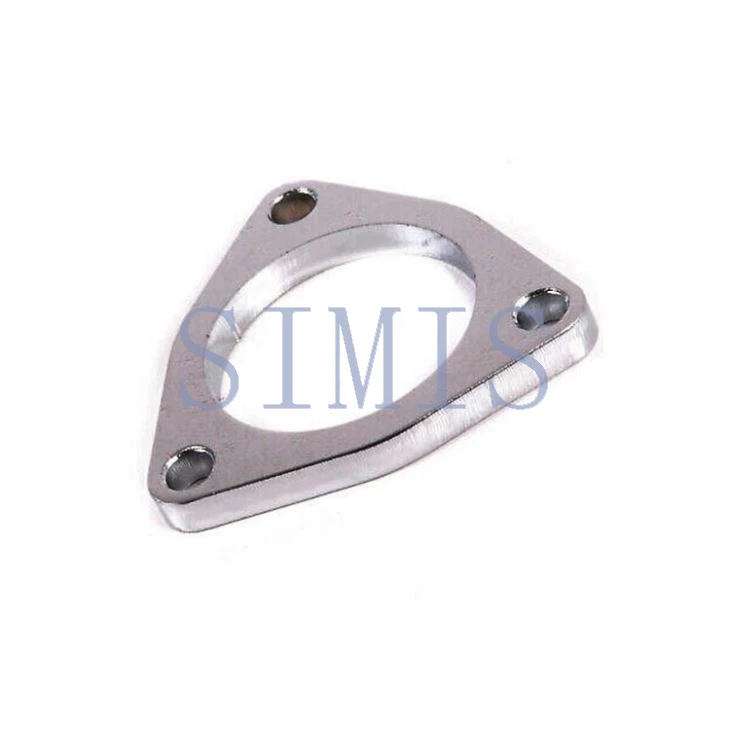
In the automotive industry, steel clamps are used in a variety of applications, such as Car Exhaust Flange. The torque requirements for exhaust system clamps are critical because they need to withstand high temperatures and vibrations. Incorrect torque can lead to exhaust leaks, which not only reduce the performance of the vehicle but also pose a health risk due to the release of harmful gases.
Industrial Machinery
In industrial machinery, steel clamps are used to secure various components. For example, Fans Blades Casting may require clamps to hold the blades in place. The torque requirements for these clamps must be carefully determined to ensure the proper functioning of the machinery and to prevent any safety issues.
Consumer Goods
In consumer goods, such as Sewing Machine Casting, steel clamps are used to hold parts together. While the torque requirements may not be as critical as in high - stress applications, they still need to be appropriate to ensure the smooth operation of the product.
Conclusion
In conclusion, understanding the torque requirements for tightening a steel clamp is essential for the proper functioning and safety of any application. As a steel clamp supplier, we are committed to providing our customers with the necessary information and high - quality products to meet their needs. By considering the factors that influence torque, following the manufacturer's specifications, and being aware of the consequences of over - and under - tightening, you can ensure that your steel clamps are installed correctly.
If you are in the market for steel clamps or have any questions about torque requirements, we invite you to contact us for a detailed discussion. Our team of experts is ready to assist you in finding the right solution for your specific application.
References
- Machinery's Handbook, 31st Edition
- Automotive Engineering Handbook
- Industrial Manufacturing Standards and Guidelines